
The Death of the Cafeteria: Why Workplace Dining Is Becoming Hospitality
And What It Means for Developers and Employers
By James Davella
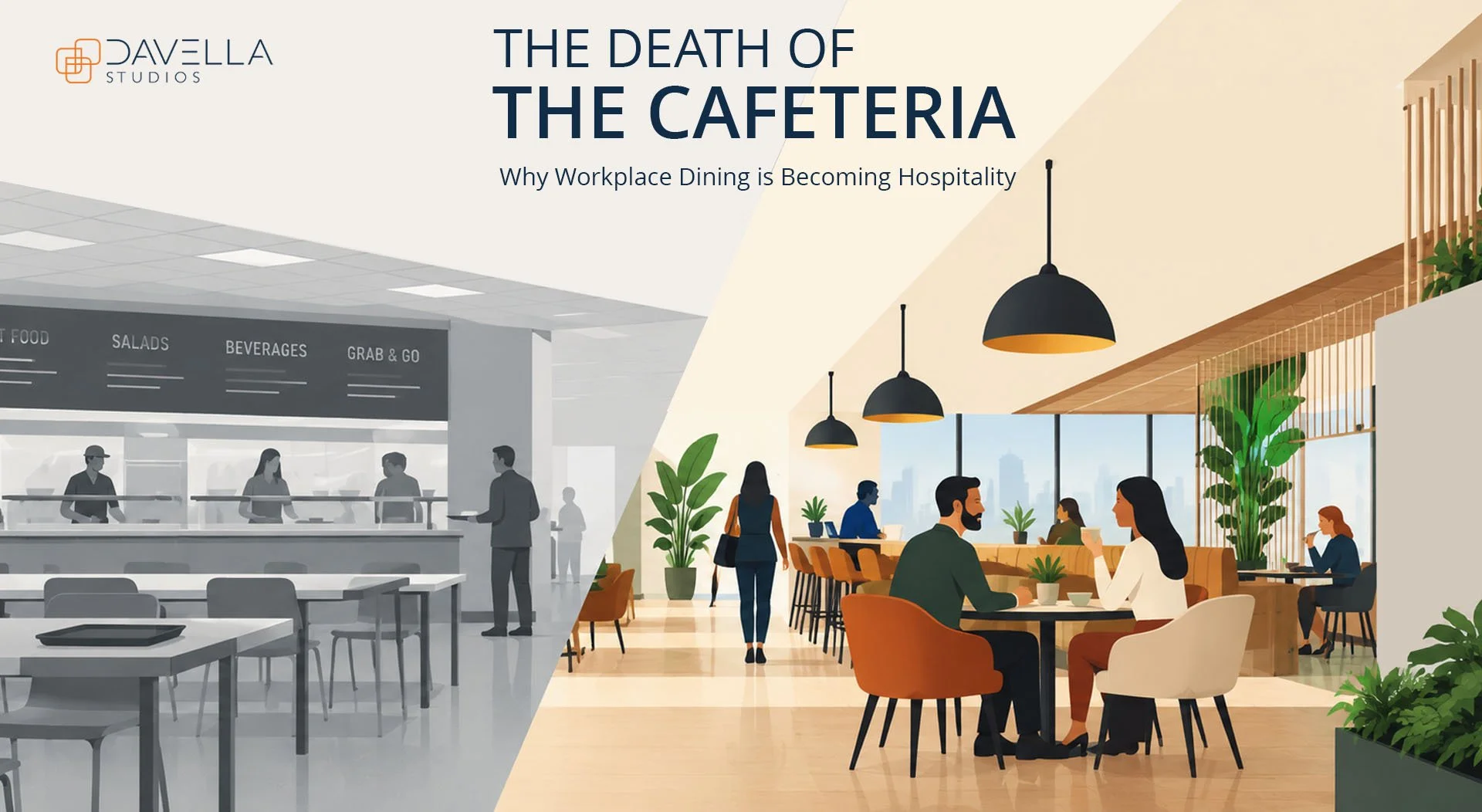
For decades, workplace dining followed a predictable model that we have all seen and experienced, most notably the centralized cafeteria with fixed service times and a limited menu variation. These spaces are designed primarily to feed people efficiently, move them through quickly, and reset for the next rush.
That model worked for a bygone era. Today, most notably Post-Covid, the difficulty is that this type of foodservice won’t drive employees back to the office. Remote workers across all sectors have had the experience and comfort of elevated, convenient, amenities outside the office, changing the game for developers and owners.
Don’t take my word for it. According to research published by JLL*, food and beverage amenities are now the number one factor that employees use when evaluating a company or job opportunity. Work life has entered a different age, where employees demand that the office experience must be equal to or better than what they have at home.
To this end, across industries particularly in technology, finance, life sciences, and corporate headquarters, we are seeing a fundamental shift in how workplace environments are designed, used, and evaluated.
It is through our design work that we’ve seen what’s working and driving value through foodservice trends.
Multi-Use Environments
Instead of a single-purpose cafeteria, dining spaces are now expected to support multiple modes of use throughout the day. Morning coffee service transitions into lunch service. Lunch service transitions into informal meeting space. Evening programming may introduce bar service, events, or extended dining.
This requires a fundamentally different design approach. Layouts must be flexible and equipment must support multiple service models. The concept must accommodate both high-volume periods and more relaxed, off-peak use.
The goal and challenge is to ensure the space performs continuously to keep the space attractive to employees and tenants throughout the day and evening.
Elevated Food and Beverage Programs
Employees no longer view workplace dining as a fallback option. They compare it directly to external restaurants, cafés, and hospitality venues.That means expectations around quality, variety, sourcing, and presentation have increased significantly.
From a design perspective, this impacts everything from kitchen configuration, service platforms, displays and pantries, as well as back-of-house workflow.
The system must be capable of supporting a higher level of output without sacrificing consistency or the guest experience. It’s a challenge that needs to be solved by both culinary decisions as well as operational design.
Flow and Throughput at Scale
One of the most common mistakes in workplace dining is attempting to replicate hospitality environments without accounting for volume.
A restaurant may serve a few hundred covers over several hours. A corporate dining environment may need to serve thousands of people within a condensed time window.
The challenge is understanding that the environment must be both hospitality (hospitable?) and efficient.
This is where system-level design becomes critical. Circulation paths, queue management, service points, and kitchen output must all be engineered to handle peak demand while maintaining a seamless user experience.
If that balance is not achieved, even the most visually compelling environment will fail operationally.
The Morris Proper at Sanofi
A clear example of this shift can be seen in our work with The Morris Proper at Sanofi.
From the outset, the objective was to go beyond the traditional workplace dining facility. We needed to develop an environment that could operate in a multi-functional way, reflecting both the scale of the organization and the expectations of its employees.
During the day, the space functions as a bright, high-volume dining environment. It supports significant output, with clear circulation and efficient service points designed to manage peak demand, without compromising on the restaurant’s look and feel. In the evening, the environment transitions.
This is an example of how foodservice adapts to create a more layered, hospitality-driven bar and dining experience. The same physical footprint supports a completely different mode of use without requiring additional space or redundant infrastructure.
This approach accomplishes two things simultaneously: it maximizes utilization across the entire day and it elevates perception without compromising performance. For developers and owners, that combination is where real value is created.
Why The Shift Matters for Developers and Owners
The shift from cafeteria to hospitality-driven dining also has direct implications for how buildings compete in the market.
Differentiation in Competitive Environments
In markets like New York, Chicago, Miami, and Los Angeles, tenants have more options than ever. Office environments are no longer evaluated on location and square footage alone.
Amenities, particularly those that are used daily, play a significant role in decision-making. A well-executed dining environment signals investment, quality, and attention to detail. A dated or purely functional cafeteria signals the opposite and drives down company value in the potential employee’s eyes.
Employee Retention and Engagement
Workplace dining influences behavior. Spaces that are flexible, well-designed, and operationally sound encourage employees to remain on-site, directly impacting performance, engagement and retention. They support informal meetings, collaboration, and extended use of the building throughout the day.
This also has a direct impact on how tenants perceive value. Buildings that actively support daily engagement are more likely to retain tenants over time.
Long-Term Asset Performance
Foodservice is often one of the last elements finalized in a project. When it is addressed late, decisions are constrained by existing infrastructure, layout limitations, and budget pressures.
The result is typically a compromised solution that meets minimum requirements but does not perform at a high level.
When part of early planning, foodservice can be integrated into the overall design strategy. This allows for a more efficient use of space, better alignment with tenant needs, and a stronger long-term performance
In other words, the build out of professional dining becomes part of the asset.
The Risk of Punting on Change
The most significant risk is the impression of being outdated. As expectations continue to evolve, buildings and companies that rely on traditional models will struggle to remain competitive.
Retrofitting these environments later is significantly more complex and expensive than addressing them correctly from the beginning. This is particularly true in large-scale developments, where foodservice infrastructure is deeply integrated into the building.
The Next Phase of Workplace Dining
The shift toward hospitality-driven environments and professional dining at work is a structural change in how workplace design is approached.
For developers and owners, the key takeaway is that foodservice matters. It must be designed for performance, to entice employees, and drive future value.
That requires a different mindset and evolved way of thinking from day one. Now, everyone must ask, “How does this system operate at scale, across the entire day, and over the life of the company or the asset?”
The Workplace Dining Endgame
The cafeteria model was built for a singular purpose; efficiency at peak demand. Today’s workplace demands a hospitality experience throughout the day.
Professional dining environments that are flexible, scalable, and capable of supporting a higher level of daily use are winning the long term investment game, both in market value and employee retention.
The buildings that recognize this, and design for it early, will have a clear advantage. Those that don’t will spend the next decade trying to catch up.
If you would like to see more about our project with The Morris Proper at Sanofi, along with our other professional dining work, please visit our Portfolio.
About the Author:
James Davella is the Founder and President of Davella Studios. Read more about James HERE.
Footnote:
*According to JLL research, staff restaurants and cafés are now the top two most important office amenities for employee satisfaction, with 62% of employees stating that food and beverage amenities influence their decision to work on-site. Quality food, specifically, is a top priority for employee wellness, driving attendance and fostering a positive workplace culture.